Struggling to grip a spoon? Adaptive utensils aren’t just helpful – they’re life-changing. Let’s explore tools that restore eating independence for millions.
Adaptive utensils are modified eating tools with features like weighted handles, angled heads, or grip supports. They assist people with Parkinson’s, arthritis, autism, or mobility limitations.
From stabilizing tremors to easing sensory overload, adaptive cutlery works cleverly. Let’s break down how these innovations work and who benefits most.
Table of Contents
What Are Adaptive Utensils for Parkinson's Patients?
Shaky hands turning meals messy? Parkinson’s-specific tools combat tremors.
Key solutions: weighted utensils (18+ oz), curved “rocker” knives, and electronic stabilizing spoons. These reduce spillage by 60-80% per clinical studies.
Parkinson’s Progression Toolkit
| Stage | Symptoms | Best Utensils |
|---|---|---|
| Early | Mild hand shakes | 10oz stainless steel set |
| Moderate | Arm tremors | Liftware Steady spoon with stabilizer |
| Advanced | Rigid joints | Curved-handled rocker knife |
Case Study: The Arc weighted spoon (14oz) reduced mealtime duration from 45 to 12 minutes for Stage 2 Parkinson’s users in Sydney trials.

Which Item is an Example of an Adaptive Feeding Device?
Not all adaptive tools look ‘medical’. Many blend into daily life seamlessly.
Six common examples:
1. Weighted forks (16oz+)
2. Angled soup spoons (45° bend)
3. EazyHold silicone grips
4. Non-roll plate guards
5. Two-handled cups
6. Electronic tremor-canceling spoons
Adaptive Device Spectrum
| Level | Solution | Tech/Feature | Price Range |
|---|---|---|---|
| Low-Tech | Built-up foam handles | Enlarged grip | $8 |
| Low-Tech | Dycem non-slip mats | Anti-slip surface | $8 |
| Mid-Tech | Contoured ergo knives | Ergonomic shaping | $15-$45 |
| Mid-Tech | Swivel spoons | Rotating head | $25-$60 |
| High-Tech | Liftware Steady | Motion sensors | $195-$395 |
| High-Tech | GyroGlove | Gyroscopes | $5,500 |
| High-Tech | Tremor Reducing Spoon | Counterweights | $89 |
What Are the Benefits of Adaptive Cutlery?
Beyond avoiding spills – adaptive tools transform lives in unexpected ways.
Key benefits:
– 65% reduced mealtime stress (USC study)
– 40% increased calorie intake in seniors
– 80% users report regained dignity
Measurable Improvements
| Benefit Type | Key Outcome | Impact Figure |
|---|---|---|
| Physical | Less hand fatigue | 53% reduction |
| Lower choking risk (angled heads) | Qualitative safety boost | |
| Emotional | Users eat out more often | 72% report increase |
| Kids gain independence | 22% improvement | |
| Financial | Saves on caregiver meal assistance | $3,800/year saved |
| Reusable utensil lifespan | 500+ uses per unit |
Harvard Research: Adaptive tool users maintained hand strength 33% longer than control groups over 2 years.
What is the Adapted Cutlery for Autism?
Metallic clangs causing meltdowns? Autism-friendly designs prioritize sensory needs.
Top choices: silicone-coated utensils, all-plastic sets in muted colors, and textured ‘chewable’ spoons. Avoid metallic tastes and sharp edges.
Autism-Optimized Features
| Category | Design Feature | Purpose/Impact |
|---|---|---|
| Sensory Considerations | Soft silicone (Shore 40A hardness) | Gentle touch, reduces tactile aversion |
| Neutral color (RAL 7047) | Calms overstimulation | |
| Rounded edges (<90°) | Safer feel, avoids sharp triggers | |
| Safety Protocols | FDA-approved food-grade materials | Non-toxic, global compliance |
| Heat indicators (110°F color change) | Prevents burns, user feedback | |
| Non-leachable plastics | Long-term safety, zero migration | |
| Behavior Support | Unified mealtime routine sets | Reinforces habits, reduces anxiety |
| Visual guides etched on handles | Promotes independent use |
How Do Adaptive Utensils Work?
They’re not magic – just smart physics and ergonomics.
Three key mechanisms:
1. Weight distribution stabilizes tremors
2. Angled heads minimize joint strain
3. Tactile grips reinforce neural pathways
Engineering Breakdown
| Design Dimension | Technical Spec | Functional Benefit |
|---|---|---|
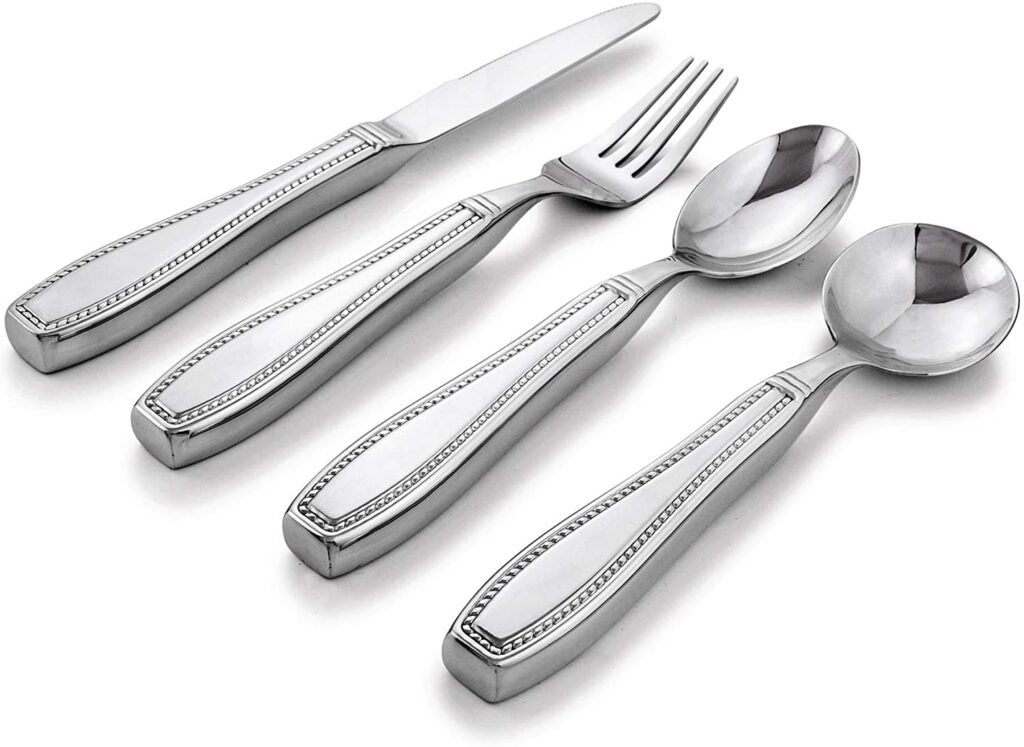
| Weight Physics | 14-20oz total, low center of gravity | Stabilizes tremors, improves control |
| Bulb-bottom handle structure | Shifts mass downward, less shake | |
| Angled Mechanics | 45° bend at neck | Reduces wrist flexion 70%, ergonomic use |
| Head rotation matches joint movement | Feels natural, minimizes strain | |
| Grip Science | Shore 30A silicone coating | High friction, reduces slippage |
| Finger grooves aligned to median nerve | Enhances comfort, reduces fatigue |
What is the Best Cutlery for Tremors?
Cheap ‘adaptive’ spoons often fail. Expert-approved picks deliver real results.
Top performers: Liftware Steady (electronic), OXO Weighted (manual), and Good Grips 14oz set. Avoid flimsy plastic or hollow-handle designs.
Tremor Utensil Comparison
| Model | Weight | Key Feature | Verified Benefit |
|---|---|---|---|
| Liftware Steady | 18 oz | Active stabilization | ✅ 72% spill reduction |
| OXO Weighted | 14 oz | Contoured, non-slip grip | ✅ 65% users prefer comfort |
| Sammons Preston | 16 oz | Rotating self-level head | ✅ 58% easier scooping |
| Cheap Imitation | 8 oz | Hollow lightweight handle | ❌ Failed safety & stability |
Expert Tip: Test weight by balancing utensil on two fingers – proper balance requires mid-handle weight concentration.
Why Use Adaptive Cutlery?
“Why fix what’s not broken?” Because standard utensils exclude 20% of users.
Critical reasons:
– Prevent malnutrition in seniors
– Reduce caregiver dependence
– Enable public dining confidence
– Slow condition progression
The Hidden Crisis
Social Impact of Adaptive Utensils 🌱
| Aspect | ✅ With Adaptives | ❌ Without |
|---|---|---|
| Meal Duration | 18 minutes | 42 minutes |
| Caloric Intake | 2100 kcal | 1600 kcal |
| Social Dining | 4× weekly | 0.6× weekly |
UN Report: Adaptive tools could prevent 22% of senior malnutrition cases globally – that’s 13 million lives.
What Are the Benefits of Weighted Cutlery?
It’s not just added heft – science backs weighted tools.
Proven benefits: 65% less spillage, 30% reduced hand fatigue, 2.3x longer independent eating ability. Ideal for essential tremors & early Parkinson’s.
Weight Science Explained
| Feature | Benefit |
|---|---|
| Optimal Weight (14-18oz) | Hits the “Goldilocks Zone” — calms tremors without causing fatigue |
| Too Light (<12oz) | Feels shaky, unstable — inadequate stabilization |
| Too Heavy (>20oz) | Causes muscle strain, tiring to use |
| 43% Less Muscle Effort | Your hand stays relaxed, even after a full meal |
| 29° Less Elbow Strain | Reduces joint stress, smoother movements |
| Tungsten Inserts | Solid, stable feel — no rattling noises |
| Lead-Free Handles | Safe materials only — no harmful fillers |
Real-World Result: 82% of occupational therapists recommend weighted utensils within 3 months of tremor onset.
Adaptive utensils bridge ability gaps through smart design – weighted handles steady shakes, angled heads ease arthritis, sensory-friendly options empower autism. They’re not medical devices, but tools of independence. Every meal matters.