Struggling to find trustworthy hotel suppliers in China? Worried about poor quality and lack of support? This choice impacts your hotel’s reputation and budget.
**Prioritize durability and after-sales support. Ask partners for data from [commercial dishwasher tests](https://en.wikipedia.org/wiki/Wikipedia:Unusual_articles)[^1] proving wear and corrosion resistance. Also, check for value-added services like maintenance training to ensure long-term reliability and value for your investment.**
I’ve spent years helping hotel procurement officers navigate the vast market of Chinese suppliers. It is very easy to get lost in a sea of attractive prices and grand promises. My experience has taught me that asking the right questions is the key to finding a truly reliable partner. A few targeted inquiries can reveal a supplier’s true capabilities. Let’s dig into the technical details that separate durable, high-quality hotel cutlery from the products that fail within months. This knowledge will protect your investment and your brand’s reputation.
## Can PVD Coated Cutlery Withstand Commercial Dishwashing Hazards in Luxury Hotels?
Worried your beautiful PVD cutlery will fade after a few washes? Are you concerned about wasting your budget on coatings that don’t last in commercial dishwashers?
**Yes, professional-grade PVD cutlery can. The key is the technology. It is not a surface film but a color embedded into the steel through ion sputtering, bonded with a hard TiN base layer. This ensures it survives over 1000 industrial wash cycles without fading.**
The difference between a PVD coating that lasts and one that flakes off comes down to the science of the application process. Low-cost suppliers often use a simple decorative coating that sits on the surface. This is not true Physical Vapor Deposition. [True industrial-grade PVD](https://en.wikipedia.org/wiki/Physical_vapor_deposition)[^2] is a molecular process.
### The Science Behind True PVD Durability
High-quality PVD involves placing cutlery in a vacuum and bombarding it with ions of a hard material, like Titanium Nitride (TiN). This process doesn’t just paint the surface; it embeds the color and the hard protective layer directly into the steel’s crystal lattice. Before this, a crucial [ultrasonic vacuum activation](https://en.wikipedia.org/wiki/Chemical_vapor_deposition)[^3] step cleans the steel at a microscopic level, ensuring a perfect bond. This robust, integrated layer is what makes the cutlery immune to the high temperatures and strong alkaline detergents found in [industrial dishwasher](https://en.wikipedia.org/wiki/Dishwashing)[^4]s.
### What to Ask Your Supplier
To ensure you’re getting durable PVD cutlery, you need to ask technical questions. Here is what I advise my clients to ask:
| Question for Supplier | Why It Matters | Red Flag Answer |
| :— | :— | :— |
| “What is your pre-treatment process?” | Proper pre-treatment ensures a clean surface for a strong bond. | “We just clean it with alcohol.” |
| “Can you provide wash cycle test data?” | This proves durability. A good supplier has data for 1000+ cycles. | “Don’t worry, it’s dishwasher safe.” (with no data) |
| “What is the base layer material?” | A hard base layer like TiN is crucial for scratch resistance. | “We use a special colored coating.” |
This technology is the core requirement for large B2B projects. It ensures the cutlery won’t lose its color after thousands of washing cycles, protecting the hotel’s image and investment.
## Forged vs. Stamped: Why Pay a 20% Premium for Forged Handles in Luxury Hospitality?
You see a 20% price jump for forged cutlery and wonder if it’s really worth it. Stamped cutlery seems good enough, so why should you spend more on forged?
**You pay for superior density, balance, and strength. Forging aligns the [metal’s grain structure](https://en.wikipedia.org/wiki/Stainless_steel)[^5], making it highly resistant to bending. This density also allows for a smoother polish, preventing corrosion and lowering the total cost of ownership by over 30% in the long run.**
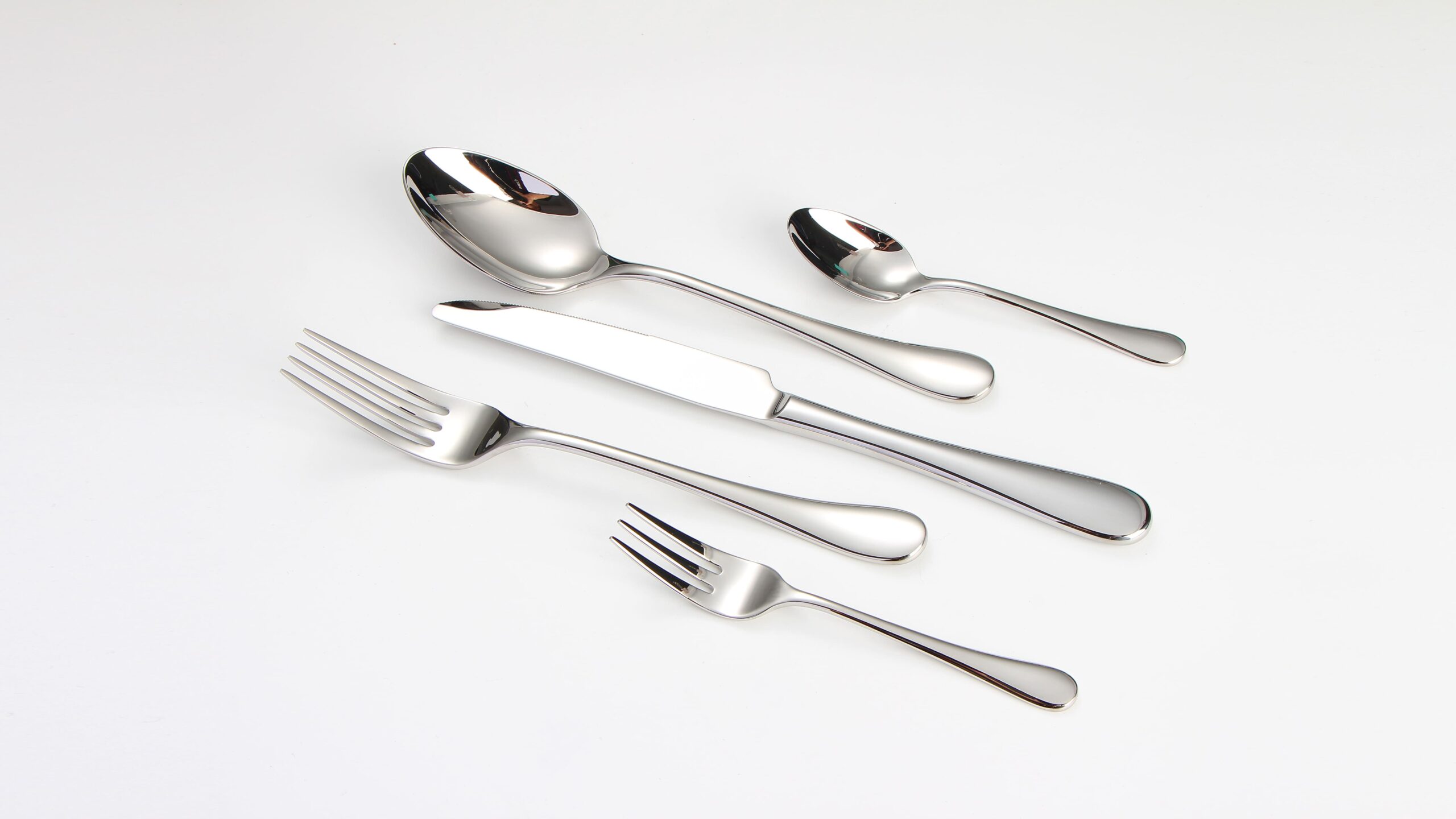
That 20% premium is an investment in the product’s lifespan and the guest’s experience. From a manufacturing perspective, forging is a much more intensive process than stamping, and the results are fundamentally different at a molecular level.
### Strength Where It Counts
Stamped cutlery is cut out from a large sheet of stainless steel, like a cookie cutter. The [metal’s grain structure](https://en.wikipedia.org/wiki/Stainless_steel)[^5] is random. Forging, on the other hand, involves heating a piece of steel and hammering it into shape. This process forces the metal’s grains to align with the shape of the cutlery. This aligned structure dramatically increases the fatigue strength, especially at the neck—the thin point where the handle meets the head of a fork or spoon. This is why forged cutlery resists bending from repeated, heavy use in a busy hotel restaurant.
### The Hidden Value of Surface Density
The forging process also creates a denser metal structure. This density allows the cutlery to be polished to a much smoother finish, which is measured by its Ra value (surface roughness). A lower Ra value means a smoother, more mirror-like surface. This isn’t just about looks. A smooth surface has no microscopic pits for food particles or harsh detergent chemicals to get trapped in. This greatly improves resistance to the pitting corrosion that can ruin cheaper cutlery.
| Feature | Stamped Cutlery | Forged Cutlery |
| :— | :— | :— |
| **Manufacturing** | Cut from a sheet of steel. | Heated and hammered into shape. |
| **Density** | Lower, uniform grain structure. | Higher, aligned grain structure. |
| **Strength (Neck)** | Prone to bending over time. | Highly resistant to bending. |
| **Balance** | Often handle-light and unbalanced. | Excellent weight and dynamic balance. |
| **Long-Term Cost** | Higher replacement frequency. | Lower [Life Cycle Cost (LCC)](https://en.wikipedia.org/wiki/Value_theory)[^6] >30%. |
Ultimately, paying for forged cutlery reduces the total cost of ownership. It lasts longer, looks better, and feels more substantial, enhancing the guest’s perception of quality.
## Why Does Your “18/10” Hotel Cutlery Still Develop Rust Spots in Industrial Washers?
Are you frustrated by rust spots on your expensive “18/10” stainless steel cutlery? You paid for a quality material, but your flatware is already showing signs of corrosion.
**It’s likely due to a poor passivation layer and high surface roughness. Cheap manufacturing skips crucial steps, leaving microscopic pits that trap corrosive detergents. True quality involves vacuum passivation, creating a dense protective layer that withstands harsh industrial washing.**
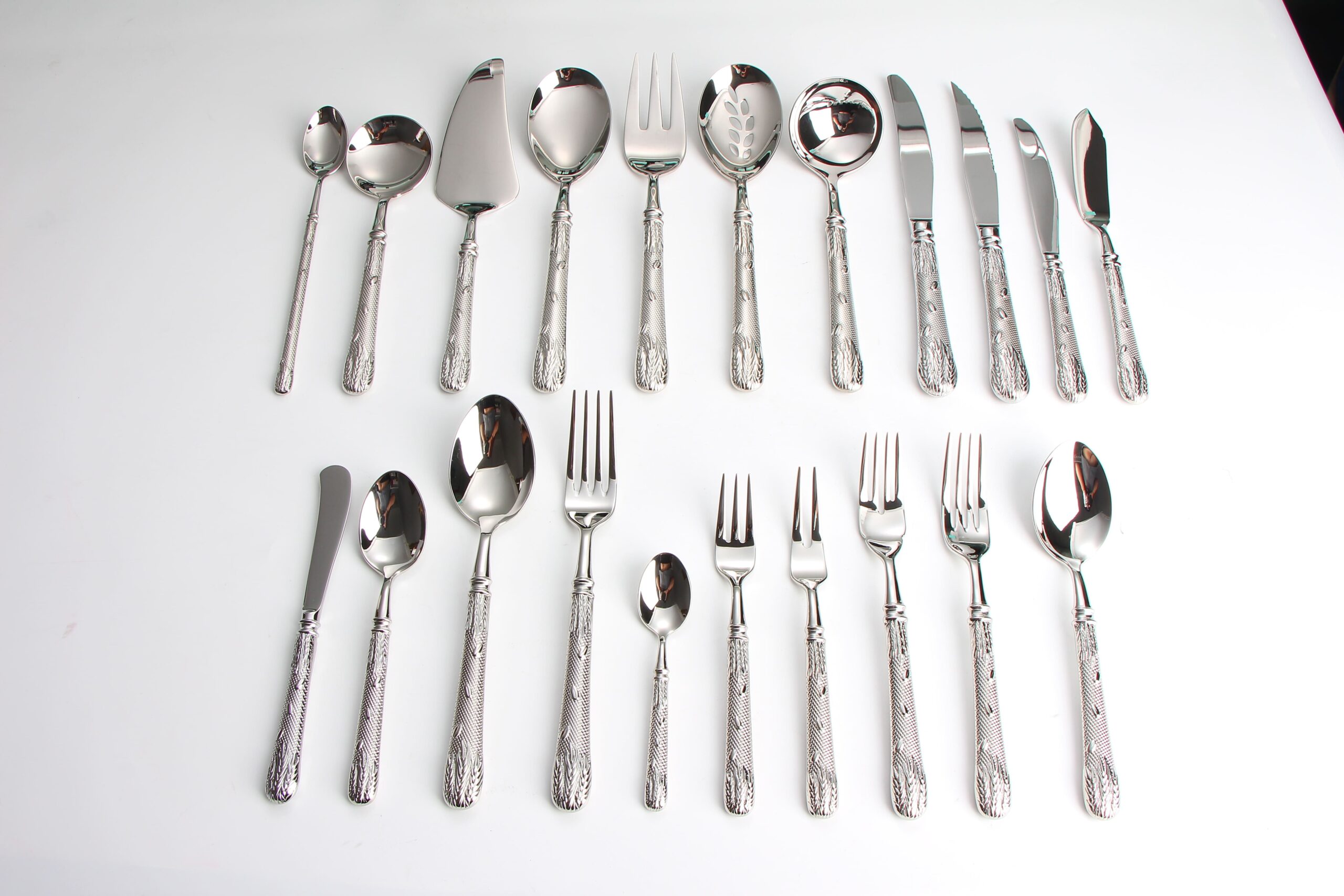
Many of my clients come to me with this exact problem. The “18/10” stamp, which refers to 18% chromium and 10% nickel, should indicate high corrosion resistance. However, the material itself is only half the story. The manufacturing process is what truly determines its performance.
### The Myth of “Rust-Proof” Steel
First, it’s important to understand that “stainless” steel is “stain-less,” not “stain-impossible.” Its resistance comes from a very thin, invisible layer of chromium oxide on the surface. This is called the passivation layer. If this layer is weak or damaged, the steel underneath will rust, especially when exposed to the chlorides found in water and detergents.
### How Low-Cost Manufacturing Creates Rust
Low-cost factories often cause this problem in two ways. First, they rush the polishing process. This leaves the surface with a high Ra value, meaning it’s rough at a microscopic level. These tiny pits and scratches trap salt and detergent ions. Second, and more importantly, they often skip the final passivation step. A quality manufacturer will use a process like acid pickling or vacuum passivation to chemically force the creation of a thick, dense, and uniform protective layer. Cheap factories rely on the natural, weaker passivation that forms in air, which is easily broken down by the high heat and strong alkaline chemicals in a commercial dishwasher.
| Process Step | High-Quality Manufacturing | Low-Cost Manufacturing |
| :— | :— | :— |
| **Polishing** | Multi-stage process to reduce Ra value. | Rushed process, leaves high Ra value. |
| **Passivation** | Vacuum passivation or acid pickling. | Skipped or relies on natural air passivation. |
| **Result** | Dense, chemically inert protective layer. | Weak, pitted surface prone to rust. |
When sourcing, you must ask potential suppliers about their polishing and passivation processes. This technical detail is a clear indicator of a manufacturer’s commitment to quality and a product’s true long-term durability.
## Why “Heavy Weight” and “Mirror Polish” Dominate the US Hospitality Sourcing Trend?
Have you noticed how US hotels often specify heavy-weight, mirror-polished cutlery? Do you wonder why this particular combination is so important for their procurement managers?
**It’s about perception and practicality. Heavy weight signals quality and durability to the guest. A flawless mirror polish looks luxurious and is easier to clean, which lowers the hotel’s long-term operational costs. This combination delivers both brand image and efficiency.**

As a manufacturer who has completed many orders for the US market, I can tell you this trend is very consistent. It is a smart sourcing strategy that is rooted in guest psychology and operational efficiency. It’s not just a matter of preference; it’s a calculated business decision.
### The Psychology of Weight
In a guest’s hand, heft equals value. A heavy, well-balanced fork feels substantial and luxurious. It non-verbally communicates that the hotel cares about quality and has not cut corners. This is a small but powerful detail in the overall dining experience. Lightweight, stamped cutlery, by contrast, can feel flimsy and cheap, which detracts from the perception of a premium brand. The weight is often the first tangible interaction a guest has with the quality of the establishment’s offerings.
### The Practicality of a Perfect Polish
A mirror polish is not just for visual appeal. As we discussed earlier, a perfectly smooth surface has a very low Ra value. This means there are fewer microscopic places for bacteria and food residue to hide. This makes the cutlery:
* **More Hygienic:** It’s easier to sanitize completely in the dishwasher.
* **Easier to Clean:** It reduces washing time, water usage, and the need for staff to re-polish items, lowering labor costs.
* **More Durable:** The smooth surface is naturally more resistant to staining and pitting corrosion.
| Feature | Guest Perception | Hotel Operational Benefit |
| :— | :— | :— |
| **Heavy Weight** | Luxurious, high-quality, substantial. | Implies durability, leads to lower replacement rates. |
| **Mirror Polish** | Elegant, clean, premium, hygienic. | Easier to clean, more hygienic, lowers labor costs. |
So, when a US buyer specifies “heavy weight” and “mirror polish,” they are sourcing for the total guest experience and long-term operational value, not just a utensil to eat with.
## What Does “Dishwasher Safe” Really Mean for a Hotel Procurement Officer?
You see the “dishwasher safe” label and assume it’s good enough for your hotel. But you know that a home dishwasher is nothing like your powerful commercial machines.
**For hotels, it means cutlery must survive thousands of cycles in industrial machines with high heat, harsh alkaline detergents, and physical impact. It must not rust, warp, or lose its finish. It’s a standard of industrial durability, not just home-use convenience.**

The term “dishwasher safe” is one of the most misunderstood labels in the hospitality supply industry. What it means for a retail product sold to a homeowner is completely different from what it must mean for a hotel procurement officer.
### Home vs. Industrial Dishwashing
The operating environment inside a commercial dishwasher is far more extreme than in a home unit. A retail-grade “dishwasher safe” product will fail quickly under these conditions. The difference is stark.
| Factor | Home Dishwasher | Commercial/Industrial Dishwasher |
| :— | :— | :— |
| **Temperature** | ~140°F (60°C) | 160-185°F (71-85°C) |
| **Detergents** | pH neutral or slightly alkaline. | Highly alkaline and caustic. |
| **Wash Cycle** | 1-2 hours | 1-5 minutes (high pressure spray). |
| **Frequency** | Once per day. | Dozens of times per day. |
### A Checklist for True Commercial Grade
When I work with procurement officers, I advise them to look past the simple “dishwasher safe” claim. They need to verify the specifications that guarantee performance in a commercial environment.
1. **Material Grade:** Is it 18/10 or 18/8 stainless steel as a baseline?
2. **Manufacturing Process:** Is it forged for strength and balance, especially at weak points?
3. **Surface Finish:** Has it been properly polished and passivated to resist chemical attack?
4. **Coating Adhesion (if PVD):** Does the supplier have test data to prove it withstands 1000+ commercial wash cycles?
5. **Structural Design:** Are there hollow handles that can trap water and burst, or weak points that could bend or break?
For a hotel, “dishwasher safe” is not a marketing term. It must be an engineering guarantee of performance under the extreme, repetitive stress of your daily operations.
## Conclusion
Choosing the right cutlery partner means looking beyond the initial price. Focus on tested durability, proven manufacturing processes, and long-term value to ensure your investment truly lasts.